EOLPodcast

Ep. 526 End-of-Life Planning: Small Steps to Complete the Work with Jennifer Tadjedin and Karen Callahan

Learn how “peace-of-mind” planning starts with a few small steps that are doable and make a big difference.

My guests this week, Jennifer Tadjedin and Karen Callahan, are the co-founders of The Heartwood Collective where they guide people through all facets of developing a death plan (other than financial and estate planning.) They discuss how their paths crossed as they began exploring new meaningful work around helping other people with planning and preparing for the end of life. Learn more at their website:

theheartwoodcollective.com

Watch on YouTube

Listen here:

This episode includes:

  • The power of collaboration and synergy to create new ideas
  • Why we need to begin with death education and helping people get more comfortable with death before we can make other changes
  • How their workshops normalize talking about death
  • Breaking big tasks into small steps helps people actually get the work done
  • How planning ahead helps lessen stress and grief for loved ones
  • The biggest barriers to end-of-life planning for most people
  • Some people find it easier to discuss death as they get older
  • The benefits of working in a group on end-of-life planning
  • How to choose the best person as a healthcare proxy

Links mentioned in this episode:

If you enjoy this content please share it with others and consider leaving a review on iTunes. Thanks again to all supporters on my page at Patreon.com/eolu. And thanks to everyone who has bought me a coffee or made a donation on Paypal! Your contributions make all the difference and ensure this podcast stays ad-free.

EOLPodcast

Ep. 519 Dying to Live: How Death Gives Meaning to Life with Andy Chaleff

Learn about a beautiful memoir that teaches readers how to contemplate death in order to find meaning in life.

My guest Andy Chaleff is an award-winning author, speaker, and mentor whose work explores the intersection of grief, love, and transformation. He facilitates deeply personal conversations and workshops that help people navigate life’s most challenging transitions. He is the author of 4 books including his recent memoir titled Dying to Live: Finding Life’s Meaning Through Death. He shares his insights about making peace with death and how it has shaped his life. Learn more at his website:

andychaleff.com

Listen here:

This episode includes:

  • What inspired Andy to write the book
  • How our view of death changes over the arc of life
  • Why we need to have a lot of pain resolved within ourselves in order to show up for another person
  • The “little deaths” of life as a training ground for grief
  • Our need to make peace with death
  • The dual meanings of “dying to live” and why he chose it as a title for the book
  • The value of presence at the end of life
  • Why navigating mistakes makes them even more beautiful
  • The value of writing Last Letters to people we love
  • the power of forgiveness

Links mentioned in this episode:

If you enjoy this content please share it with others and consider leaving a review on iTunes. Thanks again to all supporters on my page at Patreon.com/eolu and thank you to Alisha Jameson for making a donation on Paypal! Your contributions make all the difference and ensure this podcast stays ad-free.

EOLPodcast

Ep. 510 Training Death Literacy Educators with Francesca Lynn Arnoldy

Learn about an exciting new training to become a Death Literacy Educator and teach in your community.

My return guest Francesca Lynn Arnoldy is a doula and a published researcher with the Vermont Conversation Lab and she runs a program for Death Literacy Educators. She is the author of The Death Doula’s Guide to Living Fully and Dying Prepared, My Death Journal, The Map of Memory Lane, and Cultivating the Doula Heart. Today she discusses the importance of training educators who can help our communities grow in knowledge, understanding, and awareness of death. Learn more at her website:

francescalynnarnoldy.com

Listen here:

This episode includes:

  • What is death literacy
  • Why Francesca created this program
  • Training includes curricula and also tools for running a workshop and market it
  • Who might be interested in becoming a Death Literacy Educator
  • Why this movement needs space holders and not exclusively people who are dealing with death and loss themselves
  • What students experience during this training
  • Importance of sharing stories about death and grief
  • How the training helps students find clarity in their teaching and determine the content they prefer to teach
  • Tutorials and tools offered during the training
  • Grant created with Compassion & Choices to provide special training
  • The value of “attentional listening”

Links mentioned in this episode:

If you enjoy this content please share it with others and consider leaving a review on iTunes. Thanks again to all supporters on my page at Patreon.com/eolu, especially my newest patron Stephanie Heilker, and to Curtis Robertson who made a donation on Paypal! Your contributions make all the difference and ensure this podcast stays ad-free.

EOLPodcast

Ep. 485 Highlights of 2024: The Best of the Best with Karen Wyatt MD

Find out what you may have missed in 2024 if you haven’t listened to every episode!

In this solo episode I recap some of the episodes of this podcast that had the greatest impact on me personally and professionally! All of the interviews from 2024 were fantastic but if you missed any of these be sure to take a listen! Thanks for your support this year! Looking forward to another amazing year – be sure to subscribe and leave a rating and review if you enjoy this content.

HAPPY NEW YEAR AND MANY BLESSINGS TO YOU AND YOUR BELOVEDS!

Watch on YouTube

Listen here:

Links mentioned in this episode:

If you enjoy this content please share it with others and consider leaving a review on iTunes. Thanks again to all supporters on my page at Patreon.com/eolu, especially my latest supporters Nancy Walker and Linda Fennigbauer and thanks to Linda for also making a Paypal donation! Your contributions make all the difference and ensure this podcast stays ad-free.

EOLU Blog

What Forrest Gump Teaches Us About Death and Dying

by Karen Wyatt MD

The classic movie Forrest Gump (1994), directed by Robert Zemeckis, has been described by some as a profound social commentary and a historical depiction of southern culture, and by others as a model of man’s resiliency. But on closer look, Forrest Gump, the tale of a simple man negotiating a complex world, can actually be interpreted as a film about death and dying with some important lessons for us to learn on this subject.

Throughout the film Forrest tells stories of historical events that involve the deaths of various iconic figures such as Elvis Presley, John F. Kennedy, Bobby Kennedy, Martin Luther King, and John Lennon. He matter-of-factly talks about each man’s death and sums up his own lack of explanation for these tragedies with “for no particular reason” or “I don’t know why,” reminding us that death is a mystery that very often cannot be understood from a rational perspective.

But Forrest also faces death on a personal level as he must endure the loss of three of the most important people in his life: his Momma, his “best good friend” Bubba, and his beloved Jenny, who won his heart the moment he first laid eyes on her. As we watch Forrest cope with death in his uncomplicated and imperturbable manner there are certain lessons that shine forth for each of us about death and dying:

“You never know what you’re gonna get.”

    This is the corollary to Forrest’s most famous adage: “Life [and also Death] is like a box of chocolates.” One of our greatest struggles is the fact that life and death are uncertain. We have no way of knowing when or how we will die and must live with our questions and take our chances as we move through this world. 

    Even if we demand control over death by choosing to take it into our own hands, there are still no guarantees: the method we choose to hasten death might fail, we might change our minds at the last minute, or we might even die by some other cause before the date of our planned death.

    So we have to reach into the box of life, not knowing what we will get, and make the best of whatever we draw out. Forrest is okay with this reality of life and models for us, in his Zen-like fashion, that sometimes not-knowing and simply accepting things as they are can be the highest form of wisdom.

     “If I’d known this would be the last time we’d talk I’d have thought of something better to say.”

    These are Forrest’s words as he reflects on his last moments with his “best good friend” Bubba who dies during a firefight in Vietnam. Forrest reminds us that our words may be the last gift we will ever give to our loved ones and we should choose them carefully. Any moment with someone we care about could be our final opportunity to express our love and admiration, so let’s not waste a single one. The last words our loved ones hear us utter need not be profound or deeply wise, but wouldn’t it be sweet if those words spoke of love and compassion?

    “It’s my time—just my time.”

    With these few words, Momma explains to Forrest in simple terms that death has its own time frame, as the verse from Ecclesiastes 3:2 states, there is “a time to be born and a time to die.” Momma accepts her dying with calmness and fearlessness that reassure Forrest and help him see that even a painful loss can be perfect in a way. 

    Lieutenant Dan believed that “his time” was to die during the war as a hero, but when Forrest saved his life he had to recognize eventually that his path had something else in store for him. We really cannot say what the timing of death will be or should be—we can only observe it and marvel that death always arrives with its own sense of mystery. 

    “Death is just a part of life.”

    Forrest recalls these words from his Momma as he copes with losing his dear Jenny. At this point in the story it becomes clear that this simple truth has been an important message of the entire film: Death cannot be separated from life. 

    In fact, death is a necessary part of the cycle of life and should be accepted as a natural, though painful, process. Forrest is able to grasp this concept and use it as his lens for looking at all of the events of his own existence, which is evidence that life and death are not necessarily difficult to understand. But we tend to complicate them by overthinking and overreacting emotionally to the circumstances that occur. Forrest teaches us to take a step back and look at life and death without expectations or attachments.

    “I couldn’t tell where Heaven stopped and Earth began.”

    When Jenny asks Forrest if he was ever afraid in Vietnam, he ends up describing to her all of the beautiful moments he remembers from that experience and also from running back and forth across the country multiple times. 

    He recalls several times when nature’s beauty was especially astounding such as when the stars came out on a clear night, a gorgeous scene was reflected perfectly upon a still lake, and the sun rose and set with all its vivid colors.  These are the moments when we recognize that Heaven is not a place to transition to—Heaven is always right here, right now, within our own perception of life and death.

     “I don’t know if we each have a destiny or we’re all just floatin’ around accidental like on a breeze. Maybe both happening at the same time …”

    With this final musing, Forrest sums up the key message of this movie: life can be like a feather floating on a breeze, randomly swayed and directed by gusts of wind that shift direction without warning. But life also, like each feather, has a purpose and a reason to exist. And both are happening at the same time. 

    When we can grasp both of those concepts, as Forrest has, we will have mastered the key to enlightenment and also the answer to the fear of dying. We don’t have to worry about death—we will float there on a breeze, but in that process we will also fulfill our greatest purpose. 

    EOLU Blog

    Why I Think About Death Every Day

    by Karen Wyatt MD

    I was 16-years old when I first began to think about my own death. A classmate of mine died from a fall while hiking, which caused me to recognize that it is possible for a young person (including me) to die at any moment. For the first time, death became real to me and since that event I have thought about death every day. In fact I might say that I have kept “death on my shoulder” like the character Billy Jack from the movies of the same name that were popular in the 1970’s.

    But I am not alone in my tendency to dwell on thoughts of death. In fact, contemplation of death is a spiritual practice in Tibetan cultures. Moreover when I recently interviewed a priest about the Catholic perspective on death he quoted St. Benedict as saying, “Remember to keep death before your eyes daily.” 

    While this might sound like a morbid practice, I can assure you that it is not. Recognizing my own mortality on a daily basis has actually changed my life in profound ways and provided many benefits:

    Gratitude for every moment of life

    Knowing that life is fleeting helps me appreciate each experience and every moment to a deeper degree than ever before. I no longer take life for granted and value the time I have been given.

    Restructured priorities

    With the briefness of life in mind I am able to focus on those things that really matter to me (like love and relationships) and let go of the superficial and trivial details that compete for my attention. I don’t “sweat the small stuff” now because I know it’s not really important.

    Taking responsibility for my life

    I now see that life is precious and the meaning it contains is up to me. No matter what has happened in my life, I am responsible to make the best of it and create as much love as I can. I no longer waste time blaming other people or circumstances for the problems I encounter.

    Looking within myself for answers

    I also have learned to seek my own answers from within rather than looking outside of myself for guidance. No one else can understand my life or my purpose better than me so I need to find my own path and follow it.

    Finding joy in being alive

    The French value the concept of joie de vivre, which literally means “the joy of being alive.” Recognizing that death could arrive at any time helps me cherish the gift of life. I wake up joyful each day because I am still here with another opportunity to experience life on this planet, even if I am sick or if life’s circumstances aren’t exactly what I would have chosen. Simply being alive is enough to create deep joy.

    Being prepared for anything

    Since I have spent a considerable amount of time contemplating my own death, it won’t really be a surprise to me if or when I hear the words “You are going to die” from a doctor some day. I have already known that fact for most of my life and I have made sure I am ready every day. While I may not be happy to hear those words I won’t be shocked or angry or depressed. Death is an important part of life and I am prepared to face that truth.

    So for me, thinking about death is a simple spiritual practice that has changed and exhilarated my life. I wish I could teach everyone that but our society remains entrenched in fear and avoidance of death. 

    But now is the time when we need, more than ever, to find joy in every moment, to be grateful for all of life, to be prepared for the future, and to shift our priorities to what really matters. Now is the time to learn to truly love life by embracing the reality of death. 

    EOLPodcast

    Ep. 474 End of Life Studies Postgraduate Program in Glasgow UK with Marian Krawczyk

    Learn about a unique postgraduate program in Scotland that offers a global and cultural context to end of life studies for a diverse group of students.

    My guest Marian Krawczyk is a medical anthropologist interested in the culture of health, illness and medicine, particularly in relation to the end of life. She is the Lead Convenor for the End of Life Studies Program at the University of Glasgow and will discuss what this program offers and what makes it unique in the field of end-of-life education. We will set the stage for future interviews with some of the graduates of the program where they will share their original research projects. Marian is also the founder of the End-of-Life Doula International Research Group, which you can learn more about at the following website:

    eold.org

    YouTube Channel

    Listen here:

    This episode includes:

    • How Marian is researching the rise of the death doula movement
    • How the Glasgow program approaches the interdisciplinary study of death and dying
    • A non-traditional pathway of entry into the program is available including an introductory microcourse and a “taster” course
    • The diversity of students who have been attracted to the program from multiple countries
    • Insights from comparative studies across different cultural and international contexts
    • Being part of the “community of the unalike”
    • Marian’s research on experiences of ecological grief related to climate change and her interest in meeting students who are drawn to this work
    • Key issues that will shape the future of end-of-life studies
    • How to learn more about the Glasgow program of End of Life Studies

    Links mentioned in this episode:

    If you enjoy this content please share it with others and consider leaving a review on iTunes. Thanks again to all supporters on my page at Patreon.com/eolu, especially to Kitty for increasing your pledge, and to Roberta Cummins for joining the $10 for 10 Years Campaign! Your contributions make all the difference and ensure this podcast stays ad-free.

    EOLPodcast

    Ep. 472 Creating a Collaborative Movement in Your Community with Michelle Kolling and Nina Guertin

    Learn why you should start a death collaborative in your community and tips for getting started.

    My guests this week are members of the Minnesota Death Collaborative and will share how the collaborative was created, including tips for others who might like to start a similar collaborative in their community or state. Michelle Kolling is a hospice volunteer and end-of-life doula who serves as secretary of the collaborative and Nina Guertin is an end-of-life doula, death educator and a co-founder of the original collaborative. They share their personal experiences and the benefits and challenges of collaborating with others. Learn more about each guest and the MN Death Collaborative at the links below:

    Michelle Kolling: heldoula.com

    Nina Guertin: tendingthespirit.care

    MN Death Collaborative: mndeathcollaborative.org

    YouTube Channel

    Listen here:

    This episode includes:

    • How the MN Death Collaborative was initially created
    • The benefits of being a member of a collaborative
    • How a collaborative organization offers credibility to those who are creating their own businesses
    • The end of life is a multifactorial experience which demands a team approach
    • How a person-centered approach is “built in” to the mission of the collaborative
    • Types of events sponsored by the collaborative
    • How to sustain a collaborative over time
    • The importance of slowing down and taking smaller steps in the beginning
    • Tips for other groups that want to start a collaborative
    • The infrastructure needed to support such a movement

    Links mentioned in this episode:

    If you enjoy this content please share it with others and consider leaving a review on iTunes. Thanks again to all supporters on my page at Patreon.com/eolu. Also thank you to Anonymous for buying me a cup of coffee and to everyone who has joined the $10 for 10 Years Campaign! Your contributions make all the difference and ensure this podcast stays ad-free.

    EOLPodcast

    Ep. 471 NEW SERIES – Death & Grief in Pop Culture: “Dear Evan Hansen” with Benjamin Kintisch

    Learn how death and grief are portrayed in pop culture through this new series that analyzes theater, film and music, starting with the Broadway musical Dear Evan Hansen.

    Trigger Warning: This episode contains references to suicide and grief after suicide so use your own discretion if these are sensitive topics for you. If you are struggling with thoughts of suicide and need help call or text the National Suicide Hotline at 988.

    My guest Benjamin Kintisch is a cantor, hospice and eldercare chaplain, music teacher, and the creator of Life Review: The Hospice Musical. Ben and I are teaming up for a new series on Death & Grief in Pop Culture to talk about all the interesting ways death shows up in culture, what we might learn about death and grief through the lens of pop culture, and how we can utilize popular references to death and grief to increase death literacy for ourselves and others. This week we are discussing the Broadway musical “Dear Evan Hansen.” Learn more about Ben’s work at his website:

    lifereviewmusical.com

    YouTube Channel

    Listen here:

    This episode includes:

    • Death and grief are all around us in popular culture
    • How pop culture can help us increase death literacy for ourselves and in conversations with others
    • Learning how to stay present with the pain and grief of others
    • The power of live theatre to touch our hearts and teach our minds
    • The preponderance of orphans as characters in popular films and stories
    • Death and grief in Life Review: The Hospice Musical
    • The authenticity of grief depicted in Dear Evan Hansen
    • Why this musical is transformative and uplifting at the end

    Links mentioned in this episode:

    If you enjoy this content please share it with others and consider leaving a review on iTunes. Thanks again to all supporters on my page at Patreon.com/eolu, especially my latest supporters Cheri and Mark and to Dana Tuttle for buying me 3 coffees! Your contributions make all the difference and ensure this podcast stays ad-free.

    EOLPodcast

    Ep. 469 Podcast Playlist: Death Education with Karen Wyatt MD

    Learn about some helpful episodes from the EOLU Archives that can show you how and why to start teaching others about death and dying.

    This week I’m sharing another “Podcast Playlist” which is a topic-focused deep dive into the archives of EOLU. I have created several anthologies of episodes that deal with specific subjects to make it easier for you to take advantage of the wealth of information available from previous interviews on the podcast. This playlist centers on Death Education and you’ll learn a lot about why we all need to be death educators in our communities right now, tips for creating our own classes or events, and various resources and trainings that are available to help you start to teach others. You can see the slides for this episode if you watch on YouTube at the link below or you can download a handout of the slides and a list of the presenters. There’s a lot of content here – this playlist should help you choose the episodes you want to listen to!

    Listen here:

    This episode includes:

    Links mentioned in this episode:

    If you enjoy this content please share it with others and consider leaving a review on iTunes. Thanks again to all supporters on my page at Patreon.com/eolu, especially my latest supporters Margie Blanchard and Bonnie! Your contributions make all the difference and ensure this podcast stays ad-free.

    EOLPodcast

    Ep. 422 Practices to Prepare for the End of Life with Patt Lind-Kyle

    Learn how meditation practice can help decrease the fear of death and prepare you for a peaceful end of life.


    My guest Patt LInd-Kyle is an authority on mindulness meditation, chakras, and the Enneagram who will share practices for addressing the fear of death. She is the author of 4 science and spirituality books including her latest Embracing the End of Life, A Journey into Dying and Awakening and Heal Your Mind, Rewire Your Brain. Patt is also a thought leader on how the mind and brain work together to arrive at a sense of who we are. She has studied the dying process in preparation for her own death and has become a leading authority on death and dying consciously. Patt has produced a series of guided meditations to accompany her Embracing the End of Life and Heal Your Mind, Rewire Your Brain books. Learn more at her website:

    www.Pattlindkyle.com

    Listen here:

    This episode includes:

    • Why it is important to face the fear of death
    • The benefits of meditation for confronting the end of life
    • How to start a meditation practice
    • How to let go of the need to control death 
    • How facing death helps us live life more fully

    Links mentioned in this episode:

    If you enjoy this content please share it with others and consider leaving a review on iTunes. Thanks again to all supporters on my page at Patreon.com/eolu and to those who’ve bought me a coffee! Also many thanks to all of you who joined the $10 for 10 Years Campaign! Your contributions make all the difference and ensure this podcast stays ad-free.

    EOLPodcast

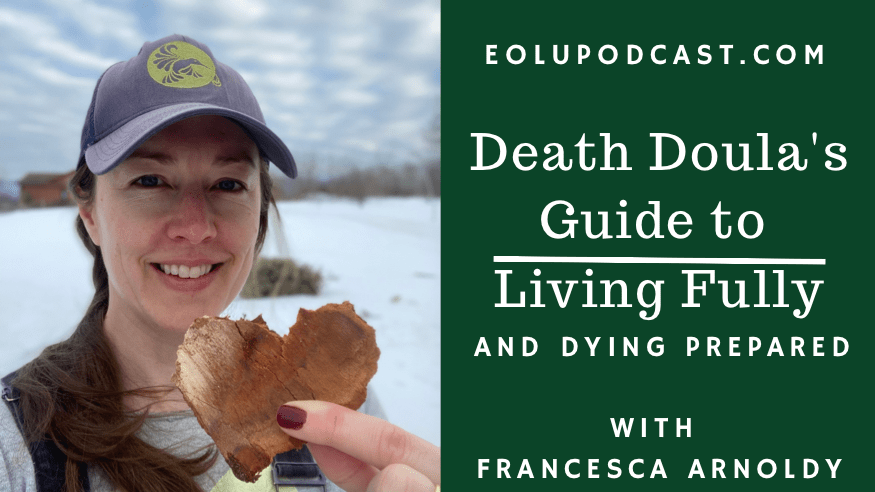
    Ep. 409 The Death Doula’s Guide to Living Fully and Dying Prepared with Francesca Lynn Arnoldy

    Learn about a brilliant workbook that helps us expand death literacy while exploring life’s deeper meaning.

    My guest Francesca Lynn Arnoldy is a doula and a researcher with the Vermont Conversation Lab. She was the original developer of the end-of-life doula training programs at the University of Vermont and is the author of three “death-lit” books. In this conversation we’ll discuss her latest workbook The Death Doula’s Guide to Living Fully and Dying Prepared. Learn more at her websites:

    www.francescalynnarnoldy.com

    www.contemplativedoula.com

    Listen here:

    This episode includes:

    • Reminder about Francesca’s previous book Map of Memory Lane and how it helps children learn about grief
    • Francesca’s main inspiration for creating this workbook
    • The value of keeping a “Death Journal”
    • How to use The Death Doula’s Guide as a death journal
    • The importance of acquiring both intellectual knowledge and inner wisdom
    • A heart-centering practice for death workers is a valuable tool
    • What death wellness means and how one can achieve it
    • The difference between sympathy, empathy, and compassion
    • How to do a life review

    Links mentioned in this episode:

    If you enjoy this content please share it with others and consider leaving a review on iTunes. Thanks again to all supporters on my page at Patreon.com/eolu and to Robin Miniter for buying me 3 coffees! Your contributions make all the difference and ensure this podcast stays ad-free.

    EOLPodcast

    Ep. 403 Death Over Drafts: Meeting People Where They Are with Stefanie Elkins

    Learn about creating opportunities in your community for conversations about death.

    My guest Stefanie Elkins is a Family Caregiver Consultant, end-of-life doula, founder of Be Present Care, and the creator of Death Over Drafts, a community event held at breweries across the country to spark meaningful conversations around death and dying. She’ll share her experience bringing end-of-life conversations to community spaces where people naturally gather and how we can make a difference in someone’s end-of-life journey by helping them talk about death and grief. Learn more about Stefanie’s work at her website:

    www.bepresentcare.com

    Watch on YouTube

    Listen here:

    This episode includes:

    • How Stefanie helps patients and families at the end of life
    • What inspired Death Over Drafts
    • Who attends Death Over Drafts and examples of the conversations that have taken place
    • Why conversations about death are important
    • Why we need to meet people where they are and bring death education to various venues and spaces
    • How to bring Death Over Drafts to your own community
    • Why end-of-life workers need to do their own work planning for the end of life
    • How families can support the aging and prepare for the inevitable

    Links mentioned in this episode:

    If you enjoy this content please share it with others and consider leaving a review on iTunes. Thanks again to all supporters on my page at Patreon.com/eolu, especially my newest donor Phyllis Wintter and to Don Zacharias for making a Paypal donation! Your contributions make all the difference.

    EOLPodcast

    Ep. 400 The Value of Death: The Lancet Commission Report with Dr. Libby Sallnow

    Learn about the important recent report from the Lancet Commission in the UK on the value of death and what each of us needs to do to help bring death back into life.

    My guest Dr. Libby Sallnow is a palliative medicine consultant and honorary senior lecturer at St. Christopher’s Hospice and the UCL Marie Curie Palliative Care Research Department, UK. She is also the co-author of The Lancet Commission Report on the Value of Death: Bringing Death Back Into Life. In addition her PhD explored the translation of a model of compassionate communities from Kerala, India to London, UK. She discusses the creation of the report on The Value of Death and its key takeaways that can form a roadmap for the reform and rebalancing of death and dying in our societies. Learn more about her work at the website:

    www.ucl.ac.uk/health-of-public/news-and-events/spotlight/spotlight-dr-libby-sallnow

    Watch on YouTube

    Listen here:

    This episode includes:

    • What inspired Libby’s interest in end-of-life care
    • The Lancet Commission on the Value of Death and what lead to their recent report
    • Why we need to rebalance death and dying
    • The “5 principles of a realistic utopia” as described in the report
    • Why we need to focus on death literacy first as we try to improve end-of-life care in our societies
    • The compassionate communities approach (to be covered in a future episode)

    Links mentioned in this episode:

    If you enjoy this content please share it with others and consider leaving a review on iTunes. Thanks again to all supporters on my page at Patreon.com/eolu, especially my latest patrons Jeff Black and Lindsay Compton, and to Brittany Ellis for your donation on Paypal! Your contributions make all the difference.