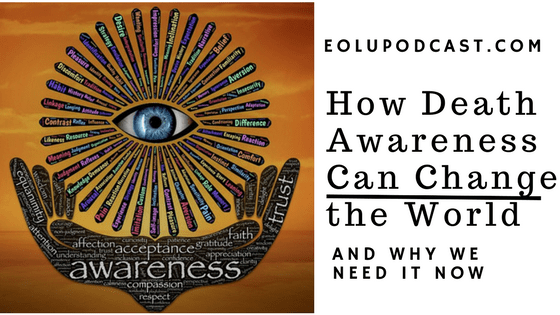
Learn about studies that have shown the positive benefits of death awareness and why we need more of it in the world.
In this episode I share some recent studies that validate the fact that being aware of death has positive effects on behavior toward others. This is evidence that we need more classes, workshops, books, films, and discussion groups about death in order to promote health, peace, tolerance, and compassion in the world.
Remember you can still sign up for the online reading group A Year of Reading Dangerously by clicking here. Join us to read one book about death, dying and the afterlife each month during 2018!
You can also get the Teaching Guidelines for a Death & Dying Class here if you are interested in teaching a class in your community or for college or high school students. In addition when you sign up for the guidelines you could become part of a work group during the month of March to create a death and dying class.
THANK YOU to all of you who help support this podcast with your donations on Patreon.com/eolu!!
FEATURE PRESENTATION:
Kenneth Vail and his colleagues at the University of Missouri recently did a review of several studies on death awareness and behavior. They found that increased death awareness was associated with several positive behaviors that could lead to needed changes in how we live our lives and connect with one another. Here are some of the findings:
Helping behaviors increased when people were given subtle reminders of their mortality, such as being near a cemetery. These positive behaviors include compassion, tolerance, empathy and pacifism.
Pro-environmental behaviors increased for people with heightened death awareness
Positive health behaviors such as quitting smoking, starting an exercise program, and performing breast self-exams increased for people who became aware of death
People with fundamentalist religious values who had previously rejected members of other religions were more likely to show compassion toward those of other groups when they experienced greater death awareness
In our world that is currently suffering with environmental degradation, polarization of society, violence, and unhealthy behaviors perhaps increased death awareness could hold some promise for our survival. Join me in improving death awareness this year by reading books and teaching classes on death and dying!
Tune in every Monday for a new episode and if you enjoy this content consider leaving a review on iTunes (thank you – it makes a big difference!)
Learn tips for teaching college students about death and dying from psychologist and educator Stacy Smith.
In this episode I share an interview with Stacy Smith who teaches a course in the Psychology of Death and Dying to students at a local community college. She’ll offer some great tips about teaching your own class and help you get inspired to become a death-ed teacher!
Stacy Smith will share how she started teaching her college class: The Psychology of Death & Dying. In this interview you’ll learn:
How Stacy got interested in teaching a college class on death and dying
How to gain support from school administration and attract students to a death and dying class
An overview of Stacy’s lesson plan for this course
Projects, assignments, guest lecturers, and field trips she recommends
Feedback from students who have taken the course
Qualities of a great death and dying class teacher
Tips for starting your own class on death and dying
Stacy Smith has a degree in counseling education and counseling psychology from the University of Colorado in Denver. She created a Legacy program for 5-18 year olds dealing with grief and loss. She has been in private practice for 14 years and specialized in grief counseling. She has been teaching in the Psychology Department at Colorado Mountain College for 5 years, including the class: The Psychology of Death and Dying. She is currently writing a book about destigmatizing mental illness and treatment.
Learn why the Death Education movement is vitally important right now for our society and get inspired to teach your own class about death and dying!
This week I’m continuing my focus on death education by discussing some important reasons why right now we desperately need more death-ed in every aspect of our society. Learn how you might become a death educator in your own community and start to share your knowledge to help others become aware of death.
You can still join A Year of Reading Dangerously and start reading books about death and dying with 700 other people around the globe! You’ll get to take part in live Q&A discussions with the authors of many of the books we are reading. For February we are reading Smoke Gets in Your Eyes by Caitlin Doughty–and she’ll be joining our discussion at the end of the month! Sign up now by clicking here!
Thanks again to all of my supporters at Patreon.com/eolu! Your generosity and encouragement mean everything to me! Become a patron for as little as $1 per month–where else can you do so much good with just $1? Go to Patreon.com/eolu to learn more.
FEATURE PRESENTATION:
Today I’m discussing why we need death education everywhere in our society and here are some of the places where it should take place:
Home – parents need to learn how to talk about death and dying with their children rather than shielding them from the reality of death
Schools – high school and college classes are a perfect place to introduce death and dying to young, curious students who can only benefit from learning more about death. (Next week I’ll share an interview on this podcast with Stacy Smith who teaches The Psychology of Death & Dying to college students, and on EOLU at the end of February I’ll present an interview about a high school elective on Death and the Meaning of Life with the teacher and 3 of his students.
Churches – clergy of all faiths need to be educated about death and dying so that they can better support their congregants on end-of-life issues within their belief system
Workplaces – employers need to understand the impact of death and grief on their employees in order to create supportive policies for bereavement leave; workers need to know how to interact with co-workers who are suffering with illness and grief
Medical system – doctors, nurses, and all other providers of healthcare need education in how to get comfortable with death, talk about it with patients and families, guide decision-making, initiate conversations with patients
Hospitals and nursing homes – need education to create sacred spaces for dying, to support patients and families at the end of life and honor patients’ wishes
Some of the reasons why death education is so important right now are:
We are living longer and the incidence of complex diseases like Alzheimer’s is increasing which creates a need for better advance planning. Patients and families need to prepare for the type of medical care and caregiving that may become necessary and understand how they can provide for those possibilities in the future.
Medical technology continues to advance at a rapid rate. Our ability to forestall death and keep a body alive has far outstripped our willingness to grapple with difficult end-of-life decisions. We need education to help people plan and prepare for the future and be pro-active about the care they receive. Studies show that those who think and talk about death are more likely to put their wishes in writing, to talk with others about their wishes, and to stop medical treatment when it is no longer helping.
Ethical and moral dilemmas about end-of-life issuesare splitting our society and families. Debates over physician-assisted dying and discontinuing medical care when it is not helping are going to increase with the aging of the Baby Boom generation. According to Pew Research Center surveys: 47% of Americans favor assisted-dying laws and 49% are opposed; 66% believe that there are times when doctors should stop treatment and allow patients to die a natural death, but 31% believe that doctors should always do everything possible to prolong life. These opposing perspectives are likely to be present in families too, especially if no advance planning has been done.
The high cost of being unprepared for death. Lack of advance care planning can lead to higher medical expenses, especially if the patient receive extreme care that was not actually warranted or wanted. Families unprepared for funeral planning are more likely to choose higher cost options and be vulnerable to unscrupulous marketing practices when they are grieving. Failure to plan ahead and put wishes in writing can cause increased stress and guilt for family members who must make decisions without any guidance.
The emotional and spiritual cost of ignoring death. As described in episode 127, death is our greatest teacher about life. Those who fail to recognize the inevitability of death are less likely to live to the fullest and appreciate the moment because they think they have plenty of time.
If you care about any of these issues and have been learning about death and dying by listening to this podcast and the End-of-Life University Interview Series, you are the perfect person to become a “death educator.” Start by sharing what you’ve learned with family and friends and consider putting together your own class in your community to help educate others.
You can download my free pdf: Teaching Guidelines for a Death & Dying Class and get some tips and tactics for starting your own community death-ed class! When you download the handout you’ll receive an invitation to a special work group I’m putting together in March on brainstorming your class.
Stay tuned to future episodes of this podcast to get more information about death education: next week I’ll share an interview with Stacy Smith about teaching college students about death and dying. On February 22nd I’ll present an interview on End-of-Life University with the teacher and students from a high school death-ed elective.
I hope you feel inspired to become a “death educator” in whatever capacity suits you, whether you simply share your knowledge with family and friends or start a class in your community!
If you enjoy this podcast please consider leaving a review on iTunes – it will be greatly appreciated!
Learn how our 100-year history of ignoring death has led to a death-phobic society and the consequences we face as individuals.
In this episode I share my thoughts on the negative effects, for individuals and for society in general, of our dysfunctional relationship with death. This topic leads into my theme for 2018: Death Education for Everyone, which you’ll be learning more about in upcoming episodes!
ANNOUNCEMENTS:
There’s still plenty of time to join the year-long reading group for 2018: A Year of Reading Dangerously. We just finished reading When Breath Becomes Air for January and are moving on to Smoke Gets in Your Eyes by Caitlin Doughty for our February selection. Click here to join the reading group!
Huge thanks to all of my current supporters on Patreon.com/eolu! I appreciate your generosity very much and also the emotional and spiritual support I derive from knowing that you are listening and that you care about the work I’m doing!
FEATURE PRESENTATION:
For the past century we here in the U.S. (and other developed nations, as well) have been gradually slipping into a state of ignorance about death. With the rise of modern medicine and the funeral industry, death has been removed from the home and from day-to-day life, allowing us to shove death into the far reaches of consciousness and to deny to ourselves that it exists.
But death is an essential component of life that cannot be ignored without causing some negative consequences. Today I’ll talk about these factors that result from ignoring death:
We think there’s always more time
We forget that life is fragile
We don’t cherish our relationships
We don’t appreciate change
We are unable to find meaning in life
We don’t live life fully
Here are the quotes I included in today’s discussion:
“Man … lives as if he is never going to die, and then dies having never really lived.” – Dalai Lama
“Death is very likely the single best invention of Life. It is Life’s change agent. It clears out the old to make way for the new.” – Steve Jobs
“Remembering that I’ll be dead soon is the most important tool I’ve ever encountered to help me make the big choices in life. Because almost everything – all external expectations, all pride, all fear of embarrassment or failure – these things just fall away in the face of death, leaving only what is true and important.” – Steve Jobs
“Death is not the greatest loss in life. The greatest loss is what dies inside us while we live.” – Norman Cousins
“Many people die at twenty-five and aren’t buried until they are seventy-five.” – Benjamin Franklin
So commit to start recognizing the presence of Death in your life every day until you can embrace and appreciate Death as a necessary component of Life. Then go out and start teaching other people to do the same thing!
Tune in each Monday for a new episode. If you enjoy this content please consider leaving a review on iTunes!
Learn how Kelvin Chin has helped people from all over the world look at and cope with their fear of death.
In this episode I share an interview with Kelvin Chin, attorney, mediator, and meditation teacher, who helps people address their fears of death individually and through workshops and lectures. He is the author of the book Overcoming the Fear of Death through each of the 4 main belief systems.
You can still join A Year of Reading Dangerously and spend 2018 reading one book each month about end-of-life topics. We’re having a great time so join us! Click here to learn more.
Thanks as usual to all my supporters on Patreon.com/eolu! I’m so grateful for your donations – they help me keep this podcast and the End-of-Life University Interview Series on the air!
FEATURE PRESENTATION:
My guest Kelvin Chin is the Executive Director and Founder of Overcoming the Fear of Death Foundation. Kelvin will share his experiences providing free counseling for people from all over the world to help them reduce their fear of death regardless of their belief system or culture.
In this interview you will learn:
How Kelvin started doing this work
The 4 Main Belief Systems about Death that cover all religions and cultures
How to help yourself or others overcome the fear of death
Why inner change is more important than changing external beliefs
How Kelvin’s talks and lectures about the fear of death are helping to reduce that fear for his audiences
The benefits of meditation in coping with our fears
Kelvin’s book is now available on Amazon. (NOTE: If you use my affiliate link to purchase the book I will receive a small commission from Amazon, which will not affect the amount you pay. Thank you!)
Tune in every Monday for a brand new episode! Leave a review on iTunes if you enjoy this content – I greatly appreciate it!
Learn some steps you can take NOW to ensure that you will be at peace when you reach the end of life.
This week I’m sharing with you my reflections on what it takes to be at peace when you die. I just observed the 5th anniversary of my Mom’s death and I was inspired to create this podcast by thinking about the peace she experienced at the time of her death and how she was able to achieve that!
Join A Year of Reading Dangerously and read fantastic books about death and dying all through 2018! Learn more and sign up here.
Thanks to my latest supporter on Patreon.com/eolu: Cheryl Durden! Your contribution to this podcast and to the End-of-Life University Interview Series is greatly appreciated!
FEATURE PRESENTATION:
After writing a blog this week called “Why Some People Don’t Die in Peace” I decided that I should go further and address HOW to actually be more at peace when the end of life arrives. So here are my thoughts! These are all things to start working on now in order to be at peace in the end:
PHYSICAL:
Plan ahead for your time of dying: What type of care do you want to receive? Where do you want to be when you die?
Create advance directives and talk about them with everyone (family, medical providers, clergy, friends, attorney)
Do “death-cleaning” by giving away all the things you don’t need any more
Think about where you will live and who will take care of you if you are unable to care for yourself. How have you provided for these possibilities
Make note of all of your preparations along with all of your financial and ownership information. Make sure this is accessible to family members who may need this information in the future.
Plan ahead for your funeral and burial
MENTAL:
Prepare yourself for death by reading and learning what happens at the end of life
Participate in a Death Cafe to have conversations about death
Watch films about the end of life (like “Extremis” on Netflix)
Attend workshops, classes, lectures in your community about death and dying
EMOTIONAL:
Get your emotional “house in order” by reviewing your unfinished business – who do you need to forgive? What unhealed wounds are you carrying?
Work on practicing forgiveness now
Let go of old resentments
Make amends for your own errors in the past
SPIRITUAL:
Find meaning in life, no matter how difficult the circumstances of your life
Learn to live every moment and find joy and love wherever you go
Figure out what really matters to you and make sure you are living that every day
Face your fear of death to help you overcome all fears in your life and live with more joy
Thanks for supporting EOLU! I appreciate your listening – if you enjoy this content please leave a review on iTunes. Tune in next week for another fascinating episode!
Learn from this Emmy-award winning composer how music is a form of “energy medicine” that can transform grief and the end-of-life experience.
In this episode I share an interview with Gary Malkin, composer of the music for “Graceful Passages,” a CD used in hospices around the world to comfort the dying. Gary will discuss how music has the potential to heal on a physical, emotional and spiritual level and why healthcare should include the arts in the future.
You can still sign up for A Year of Reading Dangerously and join our online reading group. For the month of January 2018 we are reading When Breath Becomes Air by Paul Kalanithi. Sign up below to receive email notifications each month and to join our stimulating conversation on Facebook and by live conference call.
As always, support for this podcast comes from my donation page at Patreon.com/eolu. Thank you to all of my current donors who are helping to keep this show and the End-of-Life University Interview Series on the air. Special thanks this week goes to Laurie Dinerstein-Kurs for increasing her pledge to the Platinum level! If you’d like to contribute (as little as $1 per month) go to Patreon.com/eolu to learn more.
FEATURE PRESENTATION:
This week I welcome Emmy winning composer Gary Malkin to talk about his CD for end-of-life transitions: Graceful Passages.
Key takeaways from this interview include:
How Gary composed the music for Graceful Passages and where the inspiration came from
How music can be used as a tool that calls people to be fully present and can be very helpful in end-of-life scenarios
Why music is helpful in times of grief
Why we should look for music that is “life-enhancing” or “positive intention” to have a soothing effect and create a response of relaxation
Science is documenting that music and other art forms can increase heart coherence, cause the release of oxytocin (the “love hormone”) and enhance immune function
Why periods of silence are important and how deep breathing and soft toning can help bridge the fear of silence
Thanks for tuning in! You’ll find a new episode every Monday so be sure to come back. Leave a review on iTunes if you enjoy this kind of content!
Hear my far-reaching dreams and ideas for changing the way people die in the U.S. in 2018.
In this episode I talk about some of my own personal goals for the New Year and then discuss a list of ideas for ways in which we need to improve all aspects of the end of life. Get some inspiration for steps you can take within your own community and in your own personal life to “Be Good at Death.”
ANNOUNCEMENTS:
I’ve started a new year-long reading group called A Year of Reading Dangerously for 2018! We’ll be exploring death and the afterlife through books that hopefully will inspire us and stretch our boundaries. Sign up to receive a monthly email with the book selection for the month and a downloadable reader’s discussion guide. Join the fun!
A HUGE thank-you to my latest supporters: Claire Turner and Dr. Leslie Robinson. Your contribution is greatly appreciated as it helps defray the costs of producing and broadcasting this podcast and the End-of-Life University Interview Series, but it also provides me with much-needed emotional and spiritual support! To donate as little as $1 per month go to Patreon.com/eolu.
There is a new pledge level on Patreon-the Platinum level-where for a donation of $5 per month you’ll receive replays of ALL of the End-of-Life University Interviews for 2018. So check it out now!
FEATURE PRESENTATION:
What we need to do to “Be Good at Death” in 2018″:
Policy Level changes needed:
Improve reimbursement for Palliative Care
Stabilize and improve reimbursement for Hospice Care
Establish a system for paying family caregivers
Medical System changes needed
Integrate Palliative Care into Primary Care and therefore …
Increase home-based palliative services
Rank hospitals according to the quality of end-of-life care provided (based on an article by Dr. Haider Warraich from Duke University). Dr. Warraich’s criteria for this ranking include:
“percentage of patients with a documented health care proxy
percentage of patients who receive heroic measures like cardiopulmonary resuscitation or cardiac defibrillation
appropriate use of hospice and palliative care
the likelihood of a family recommending the hospital for end-of-life care
whether patients’ location of death was concordant with the place in which they had wanted to die
availability of around-the-clock spiritual resources
the training the medical team receives for dealing with the medical and psychosocial issues that arise when death is imminent” ((Thank you Dr. Warraich for this fabulous idea!))
Medical Education changes needed
Train all medical providers in palliative care (at least a one-month rotation) regardless of specialty
All medical students work with dying patients in at least one rotation
Teach better conversational and listening skills to medical providers
Help medical providers process their own fears and biases toward death and their repressed grief
Learn about my Top-10 picks for people, events and trends that have changed the end-of-life movement in 2017.
In this final episode of 2017 I take a look back at the previous year and share my thoughts on some of the events and people that I believe will have a big impact on how our society deals with the end of life.
Happy Holidays!
ANNOUNCEMENTS:
You can support this podcast by making a small donation of $1 or $2 at Patreon.com/eolu.
FEATURE PRESENTATION:
Here are my picks for the 2017 Game Changers in the Death-Positive Movement:
The documentary film “Extremis” was nominated for an Academy Award for Best Documentary Short. The film was also picked up by Netflix in 2016. It is a powerful depiction of end-of-life care in the ICU staffed by Dr. Jessica Zitter, which should serve as a wake-up call to people about the need to do end-of-life planning before a healthcare crisis occurs.
Dr. Jessica Zitter’s book Extreme Measures was also released this year. In addition she wrote an article for the N.Y. Times (“First Sex Ed Then Death Ed”) calling for death education classes for all high school students. This novel idea has the potential to change our society’s perception of death and dying by introducing the subject to young people. Dr. Zitter is truly a game changer!
In March and May of 2017 the organization The Dinner Party (a movement to provide community for millennials dealing with loss) convened meetings with business leaders from some prominent US corporations to discuss loss and the workplace. They emphasized the importance of developing workplace policies and protocols for managing bereaved employees and offering them assistance. These conversations are just the first step in changing how grief is recognized and supported in the workplace rather than being ignored.
In April 2017 the 1st International Death Doula Training was held in Maui for the purpose of teaching people from around the globe to serve others as death doulas. This event was a game changer because it validated the death doula movement, increased the number of qualified doulas who can serve their communities, and provided a networking platform for death workers, which helped strengthen and expand the movement. The 2nd International training will take place in 2018!
Also in Apri the National Rx Drug Abuse and Heroin Summit was held to address the epidemic of opioid addiction in this country. Measures have been taken to limit the number of pain pills that can be prescribed and dispensed at one time. This is an important and game-changing step to deal with the overwhelming public crisis of opioid deaths but caution is necessary. We must be vigilant to ensure that all hospice and palliative care patients have access to the medications they need for pain and symptom management.
On June 27, 2017 Jon Underwood, founder of Death Cafe, died suddenly and unexpectedly at a young age. Jon has been a game changer from the beginning by creating the Death Cafe platform for conversations about death that has spread around the world. But the tragedy of his death is also a potential game changer because of the powerful legacy Jon leaves behind and because of the potential for tragedy to inspire growth, creativity and healing. The entire death-positive movement is indebted to Jon for his inspiring and gentle leadership and may his death be a catalyst for transformation.
In July a new smart phone app named WeCroak was introduced. This app is a game changer because it helps people to think about death in a positive manner by sending reminders (“You will die one day”) and quotes on their phones 5 times a day. Technology has the potential to revolutionize our approach to death and dying and this simple $.99 app is just one small step toward the change that is needed.
The film Coco was released in the US by Disney and Pixar in November. Coco tells the story of a 12-year old boy who is transported to the land of the dead on Dia de los Muertos. There he receives help from his departed great-great grandfather to return to his family in the land of the living. The film depicts joyful skeletons who dance and sing and it portrays a positive image of life after death. While it is a children’s movie Coco has a powerful message for adults and is likely to stimulate much conversation in families about death and departed ancestors. It is exciting to see Hollywood begin to address death in a positive manner and this film is a game changer that will hopefully lead to more such productions in the future.
In December the first EndWell Symposium, created by Dr. Shoshana Ungerleiderand her foundation, was held in San Francisco. This groundbreaking symposium brought together thought leaders from healthcare, design and technology to share ideas on how to improve end-of-life care. The synergy of this collaborative event will have a ripple effect across the country and should lead to innovation and creativity around death and dying in the months to come. Dr. Ungerleider is a game changer for her forward-thinking generosity and ingenuity!
Also in December the Northpoint Expeditionary Learning Academy in Prescott AZ held a class for students in grades 9-12 on “Death and the Meaning of Life.” School Director Charles Mentken taught the class, which provided a comprehensive look at death and dying from various cultural and religious perspectives. The elective class also introduced the students to options for hospice and palliative care, death doulas, home funerals, cremation, and traditional funeral and burial services. This may be the first “pilot project” course of the type Dr. Jessica Zitter called for in her NY Times article and it is definitely a game changer. The students in the course have reported that their attitudes and fears about death have been totally transformed, as well as their approach to life, as a result of what they learned in the class. (I’ll be featuring an interview with Charles Mentken and 3 of his students on the End-of-Life University Interview Series in early 2018. Sign up if you’re not already on the list!)
…
I hope your holiday celebrations have been filled with joy and light and that you feel ready to embark on a brand new year next week! There will be a new episode on New Year’s Day where I will share my “wish list” for 2018.
Learn how The Dinner Party movement helps millennials cope with grief and some tips for managing grief during the holidays.
In this episode I share an interview with Carla Fernandez and Lennon Flowers, co-founders of The Dinner Party, a movement that is helping grieving millennials find community. I also talk about some of their tips for grief over the holidays.
Check out my new blog series on Grief Travel and learn some tips for planning travel to help with grief. Go to eoluniversityblog.com to find the series and start planning your own grief travel experience.
Thank you so much to all of my Patrons who have made donations on Patreon.com/eolu this year! I am forever grateful for your support and encouragement. If you would like to help keep End-of-Life University on the air you can go to Patreon.com/eoluand pledge just $1 a month to receive bonuses like the monthly Q&A recording I call “Hospice Happy Hour.” You’ll also be able to listen to all of the replays from the recent Death Expo 2017.
FEATURE PRESENTATION:
My guests Carla Fernandez and Lennon Flowers are the co-founders of The Dinner Party, a movement to create community and meaningful conversation around the isolating experience of grief for those in their 20’s and 30’s. Younger adults often feel out of place in traditional grief support groups and Carla and Lennon will share how their own personal losses led them to start The Dinner Party, which has now grown across the U.S. and beyond.
In this interview you will learn:
The inspiration behind The Dinner Party
Why The Dinner Party reaches out to millennials
How participants benefit from attending
How to become a host for a Dinner Party
How Carla and Lennon are working to create supportive workplaces for the bereaved
What resources are available on The Dinner Party website for grief in the workplace and grief at holiday times
Wishing you and your loved ones much love, joy and light during this holiday season, no matter how you choose to celebrate. I’ll be enjoying Christmas with my family next week but there will still be a podcast episode so be sure to tune in.
If you enjoy this podcast please consider leaving a review on iTunes to help more people discover this information.
Get some great last-minute ideas for non-material gifts that don’t break your budget or end up in the landfill!
In this episode I’ll talk about why it’s great to give gifts for the holidays. And I’ll share some ideas from own “holiday gift bag” for meaningful gifts that are fun and creative and don’t add to the usual shopping and financial stress of the season.
The last Virtual Death Cafe of 2017 will take place on Tuesday December 12th at 5 pm Pacific/8 pm Eastern. Learn more here: https://iTeleseminar.com/103753281
This series was kicked off with Podcast #118: “How Travel Helped My Grief.” I’ll be sharing lots of tips for places to visit, planning a grief travel experience, and creating rituals to help you process your grief.
This podcast is supported through generous donations at Patreon.com/eolu. Thank you so much to my latest donors: Louise Kelly, Libby Gallaher, and Shannon Calvert. Your generosity means everything to me! All patrons receive the monthly Q&A Recording (Hospice Happy Hour) and will have unlimited access to the replays from this year’s Death Expo! Become a patron for as little as $1 per month and join the fun! Patreon.com/eolu
Holiday gift-giving is traditional for Christmas, Hanukkah and even Kwanzaa. Since all three of these holidays occur near the winter solstice, when daylight hours are the shortest of the entire year, their celebrations also include light as a key component, in the form of candles, Yule fires, or strings of lights used for decoration. We bring in light to counteract the darkness and we offer gifts to one another to show our love and regard.
While this gift-giving is a beautiful tradition, there is no doubt that it has become over-commercialized for those who celebrate Christmas. So much emphasis has been placed on gifts that the actual meaning of the holiday seems nearly lost in the race to buy the best presents. Sadly we live in a society where most people actually have far more “stuff” than they need or could ever use, which makes the gift-glut even worse for the environment, our pocketbooks, and our souls. It’s time to rescue the holiday from the overconsumption of material goods by changing the way we give to one another.
My family has adopted a tradition of giving one another “experiences” rather than objects. We surprise each other with creative ideas for ways to spend special time together that take place later in the year, so the Christmas spirit lasts far longer than just one day. As an example our experiences last Christmas included a wine-tasting trip, a Beatles tribute concert, a sunset picnic in San Diego, and a camping trip to Joshua Tree National Park. None of these experiences cost much money and they were all easy to plan and schedule. AND they each created special memories that will last far longer than any material possession would last.
The original Christmas gifts, from the Three Wise Men according to legend, included gold to honor royalty, frankincense to create a sacred space, and myrrh (an herb used for embalming) to remind us of our mortality. With this guide in mind we can plan our own “wise gifts” for the holidays.
In my mind, gold is represented by the giving of your time; in our lives, time is precious and when you choose to give your time to another you honor their royalty. Frankincense is replaced by the giving of your wisdom and talents--a gift of your soul–to bless your loved one. The function of myrrh is accomplished by talking about the preciousness of life and the fleeting nature of the special times we have to celebrate with one another because we are mortal.
Taking your time and talents and your impermanence into consideration, here are some ideas for experiences you might give to your loved ones this holiday season:
camping adventure
hiking trip
bird watching
concert or show tickets (to see together)
art 101 tour (if you are an art lover)
introduction to opera or symphony
craft class – like knitting, crocheting, etc. Whatever you know well enough to teach
private yoga lesson or meditation class (to take together)
cooking lesson (and share the meal after)
scrapbooking class
painting class
picnic
The basic idea is that you offer to teach what you know to your loved ones or to share an experience that’s new to both of you that you can learn from together. Some of these ideas are pricier than others (especially show tickets) but if your funds are tight you can plan a hike or a special picnic quite inexpensively.
Finally don’t forget to talk with your loved ones about the fleeting nature of life and why we must all cherish our opportunities to share these experiences together.
It’s important to get everyone to buy in to this idea before the holiday celebrations start and it may not work well for children who still expect a visit from Santa. But the gift of an experience could end up changing your holiday and your relationships for the better. I hope you’ll give it a try!
Tune in each Monday for a new episode and leave a review on iTunes if you enjoy this content! Until next week remember …
Learn about this documentary film project that examines the dying process through the eyes of nurses, directed by award-winning filmmaker Carolyn Jones.
In this episode I share an interview with Carolyn Jones, an amazing filmmaker who has turned her attention to the death and dying process here in the U.S. Through interviews with nurses all around the country and by following 4 patients on their end of life journeys Carolyn hopes to demystify the dying process and spur conversation about how to do it better.
Many thanks as usual to all of the supporters who have made donations at Patreon.com/eolu! I am forever grateful for your generosity. You can become a patron for just $1 or $2 per month by signing up at Patreon.com/eolu.
I’d also like to thank all the listeners who have written in over the past few months to express their gratitude for this podcast and for the EOL University Interview Series! I couldn’t do this without you showing up to listen in and join the conversation. Thank you to Susan O’Brien, Terry Lindsley, Don Dahlheimer, Karen Britton, Marzette Ellis, and Louise Kelly for your messages of support!
FEATURE PRESENTATION:
Today I welcome Carolyn Jones an award-winning filmmaker who has created the Dying in America Project. Her project consists of interviews with 50 hospice and palliative care nurses, and will follow the journeys of four hospice patients when it has been completed. Carolyn will share her inspiration for the project and the goals she has for the future.
In this interview you will learn:
How Carolyn’s past experiences led to this project
How Carolyn created the Dying in America videos
What can be learned from the Dying in America website
How Carolyn hopes this project will help change the way we die in this country
Carolyn Jones is an award-winning photographer and filmmaker who specializes in telling stories that shed light on issues of global concern. Her first book, Living Proof: Courage in the Face of AIDS, was published by Abbeville Press and accompanied by shows in Tokyo, Berlin, the USA, and at the United Nations World AIDS Conference. She directed a television series for Oxygen Media called Womenshands as well as Women… on Family, a program for PBS. Carolyn founded the non-profit 100 People Foundation which creates educational films and curricula for school children worldwide. She has spent the last two years interviewing nurses from all over the country for the book and documentary film: The American Nurse. For more information about Carolyn and Dying in America, visit the websites below. The Dying in America website, supported by a grant from the Jonas Center for Nursing and Veterans Healthcare, is the first phase of the project, which will culminate in a feature length documentary that will seek to change the way Americans confront death.
Learn how travel can provide a “safe container” for healing grief and loss.
In this episode I’ll share my own insights into how the experience of travel can help with the process of grief. This is also the subject of the new book I’m writing (I did research for it on my recent trip to Italy) … I’ll share a brief overview here!
You can check out all of my Italy photos onInstagram!
ANNOUNCEMENTS:
Each month I host a “Virtual Death Cafe” with fascinating conversations about death, grief and the end of life. Anyone can join by telephone or online. You can learn more about it at www.eoluniversity.com/death-cafe.
This podcast is supported through the generous donations of my patrons on Patreon.com/eolu. I’m sending a HUGE THANK YOU to all of my current supporters – your support makes a big difference! Join the fun for just $1 or $2 per month and you’ll receive the “Patrons Only” Q&A recording each month (Hospice Happy Hour!) Go to Patreon.com/eolu to learn more and sign up!
FEATURE PRESENTATION:
During several of my travel experiences in the past I have been dealing with grief and have found the process of travel to be helpful. On one trip to Italy, my husband and I learned of the death of our brother-in-law on the day we arrived in Venice. Unable to cancel the rest of our trip and return home immediately, which we wanted to do, we stumbled through the remainder of the vacation and managed to make peace with our pain.
Here are some of my “takeaways” about how travel can help with grief:
Permission to wander aimlessly. On our Venice trip we canceled all of our sightseeing plans and activities. We started each day with a totally clean slate and just wandered the streets and canals of the city all day long. By following our intuition and our broken hearts we were able to enter into our grief without distraction or attachment. Had we been at home with family we would have felt obligated to “do something” and “be somewhere” but because we were traveling we were free of all expectations.
Seeing the big picture. Because we were freed up from the details of our daily life at home, we found more space to explore grief from a “trans-personal” perspective, as something bigger than just our own individual lives. Experiencing grief in another country allowed us to:
Recognize that all people, everywhere, experience the death of loved ones. Our mortality and the grief it causes us is the interconnecting thread that binds us to all of humanity.
Go deep into history. By visiting ancient ruins we can see that all of humankind, throughout history has dealt with the pain of loss and struggled to make peace with death. Our experience of grief is just one part of a vast “whole” picture of human loss.
Surrendering to grief to find joy within. As travelers “stuck” in another country even though we wanted to be home, we had no choice but to surrender to the pain that engulfed us. When we allowed grief to find a home within (and even “became” a living embodiment of grief) we also discovered a startling capacity for simple joy over the beauty of being alive. I’ve written this before: suffering hollows us out so that we can contain an even greater measure of joy … and also love.
Understanding impermanence. Strolling through cemeteries, relics and ruined structures of the past illustrated to me perfectly that everything that exists in the physical realm is impermanent and will one day dissolve away. Only love and the energy of life persist eternally. And it is the depth of the love we experience for others that causes the magnitude of pain we feel upon their deaths. Grief is one of the visible manifestations of love in the physical realm.
Learning how to navigate in unfamiliar territory. On our “grief trip” in Venice we simply wandered every day until we were hopelessly lost. We took in everything around us along the way–noticing all the colors and sounds and fragrances of life. And when we felt ready to return “home” we studied our maps to figure out where we were and to slowly find our way back to more familiar territory. This skill of navigating in the unknown will prove to be very helpful to us throughout life and especially during our own dying process as we struggle to get back to a home we can’t remember.
I hope you will take the opportunity to travel some day, even when you are experiencing grief, to experience the profound benefits it can offer!
Tune in every Monday for a new episode of the podcast! If you enjoy this content, please share it with others and leave a review on iTunes! Until next week remember:
Learn how the practice of yoga can help heal acute and chronic grief.
In this episode I share an interview with yoga teacher Paul Denniston who has created a special workshop for healing grief using yoga and movement. He’ll share stories of his own journey through grief and how his workshop is helping others.
The Thanksgiving Holiday is approaching in the U.S. and I want to wish everyone a week of gratitude and generosity as we reflect on all that life has given us. My family will be celebrating with our Annual Thanksgiveaway: handing out care packages to the homeless. This is just a small gesture of kindness as a way of expressing our thankfulness for all of our blessings of the past year. I hope you too find a special way to share with others on this holiday!
I am especially grateful for all of my supporters on Patreon.com/eolu! Your generosity helps me feel connected to my audience and lets me know that you like the content I am creating. If you would like to become a patron you can sign up to contribute just $1 or $2 per month at Patreon.com/eolu.
Barbara McAfee has generously offered to share the following music video with all of us! She wrote the song Living Dying Man for her friend Jamie Showkeir as he faced the end of his life from ALS. Learn more at Barbara’s website: http://barbaramcafee.com
I hope you enjoy listening! Thank you Barbara for sharing with us!
FEATURE PRESENTATION:
In this interview yoga teacher Paul Denniston will discuss:
his use of yoga as therapy for grief
how various types of yoga can help release grief that has been stored in the physical body
tips and strategies for moving through grief
why laughter yoga is especially healing.
Paul Denniston teaches Grief Yoga to bereavement groups in one of the largest hospices in Los Angeles, and has taught for several years at Kripalu Center for Yoga and Health. He offers techniques and exercises to therapists, counselors and health care professionals in the United States, England and Australia. Paul has studied with some of the world’s leaders in grief work, including David Kessler, William Worden and Elisabeth Kubler Ross.
Tune in every Monday for a new episode! If you enjoy this podcast please consider leaving a review on iTunes – it will be greatly appreciated!
Learn how this unconventional therapy can help us heal from grief and trauma.
In this episode I share an interview with Dr. Linda Backman, a psychologist and regression therapist who helps people access information from previous lives and between lives. Whether or not you believe in multiple lifetimes you’ll find her work and experiences fascinating.
November 16-17 I’ll share with you a series of presentations on end-of-life issues with a variety of speakers, like Caleb Wilde of Confessions of a Funeral Director, oncology nurse and author Meina Dubetz RN, Carla Fernandez and Lennon Flowers of The Dinner Party and Larry Wildemuth, who’ll talk about the end-of-life planning game Go Wish! You’ll also be able to listen to Encore Interviews from previous Death Expo events with Stephen Jenkinson, Jerrigrace Lyons, and Kate Kalanick of The Green Burial Council.
All you have to do to join in is make sure you are on the End-of-Life University mailing list:
Dr. Linda Backman will be offering a FREE webinar on November 18th: How to Heal Through Past Life Exploration. In this webinar you’ll learn:
Why unresolved karma may be the hidden cause of chronic health issues in particular parts of your body
How you can heal chronic health issues through understanding your past lives and relationship patterns
How to heal relationship patterns and bring more love and intimacy to key relationships by discovering your past life karma and its patterns
What past life regressions can reveal about your potential lives on other planets and how these experiences may be causing you illness or emotional issues now
This interview will introduce you to Dr. Backman’s work and you will understand how powerful this type of therapy can be. You will learn:
The difference between past-life and between-life regression
How regression therapy can benefit people
When a regression is recommended as treatment
How regression can help with unresolved grief
Remember that there will be a new episode every Monday so be sure to tune in next week! Meanwhile go to Patreon.com/eolu if you’d like to become a patron for $1 or $2 per month and click here to leave a review on iTunes!
In this episode I’ll share with you some books that have come across my desk in the past year. While these books didn’t become New York Times bestsellers they each contain valuable wisdom and information that you will enjoy. Check these out and find something new to read this Autumn!
ANNOUNCEMENTS:
Death Expo 2017 is coming soon! If you’ve signed up for the End-of-Life University mailing list you’ll automatically receive access to this special series on November 16-17, 2017. You’ll hear presentations from popular speakers such as Caleb Wilde, author of Confessions of a Funeral Director,Stephen Jenkinson and Jerrigrace Lyons and you’ll learn about grassroots movements like The Dinner Party: Life After Loss and Go Wish, the end-of-life planning game.
Support for this podcast comes from your generous donations through my page at Patreon.com/eolu. This week I’d like to thank my latest patron Libby Gallaher! Thank you Libby and all of the other patrons out there who are helping to defray the financial costs of this podcast and also offering me your emotional and support! You are greatly appreciated! To become a patron go to Patreon.com/eolu.
FEATURE PRESENTATION:
Here are the books I’m featuring this year. Listen to the podcast to hear a brief description of each book or click the link to read more:
Beyond the Veil to Heaven: Inexplicable Manifestations and Signs From a Woman’s Transition to Heaven while Maintaining Earthly Life Connections by Ward Edward Barcafer Jr.
Learn about the history and cultural traditions behind Mexico’s Dia de los Muertos celebrations.
In this episode I’ll share what I’ve learned from online research and a conversation with a friend about Dia de los Muertos, the Day of the Dead celebrations, which will be taking place this week in Mexico. Join me in an inspirational look at this beautiful cultural perspective on death!
I’m getting ready for the 5th Annual Death Expo which will take place November 16-17! This year I will feature 5 brand new Keynote Interviews along with several Encore Interviews that represent the best of past Death Expos. If you are already on the EOL University mailing list (and receive emails each time a new EOLU interview is posted) you will automatically receive the Death Expo access information. But just in case … you can sign up here if you’d like to join us for Death Expo:
Also, I recently returned from an incredible month-long trip to Italy and I wanted to remind you that you can check out all my photos on Instagram if you are interested!
This week I would like to thank my latest supporter on Patreon.com/eolu: Shannon Calvert! A HUGE THANK YOU to Shannon and all of the other donors who are helping to keep this podcast on the air! If you would like to become a patron and receive the “Hospice Happy Hour” Q&A recording each month visit Patreon.com/eolu to learn more!
FEATURE PRESENTATION:
I intended to record an interview about Dia de los Muertos with my friend Alex Sánchez whose family is from Guadalajara, Mexico and who currently lives in Barcelona. Due to technical difficulties we were unable to record our conversation but I did gather a lot of helpful information from him that corroborated the online research I had completed.
Here are some of the interesting facts I learned (listen to the recording to hear all of the details):
Current Dia de los Muertos celebrations derive from Aztec traditions influenced by Catholicism. They are practiced most elaborately in the indigenous parts of Mexico (from Mexico City to the south.)
The celebrations occur on November 1st (All Saints’ Day) and November 2nd (All Soul’s Day).
Families build elaborate altars (ofrenda) in their homes with candles, marigolds, food, sugar skulls, clay skeletons, favorite items of the deceased, and even toys
Plates of the deceased’s favorite foods are placed on the altar – eating those special foods is a big part of the celebration
There is a belief that the “gates of heaven” open at midnight on October 31st (All Hallow’s Eve), allowing spirits to return to the land of the living to join in the celebration
On November 2nd the celebration moves to the cemetery where gravesites and tombs are cleaned and decorated with flowers, candles and skulls. Music, food, dancing and storytelling are all part of the day.
In Mexican culture death is considered a normal part of life–to be welcomed rather than dreaded. Skeletons and skulls are decorated with bright colors and smiles as they represent the joy of living in the face of death.
In many cities altars are placed in public squares and there are community parties and parades to celebrate the occasion but these events are less traditional and have been commercialized to appeal to tourists.
I loved learning about Dia de los Muertos because the celebration matches my own beliefs: that life is to be celebrated and death reminds us to make the most of every day. Whatever traditions and celebrations you enjoy this week I hope you take a moment to appreciate life and acknowledge that it is precious because it is limited.
Learn why you should write your story and Joanna’s tips for getting it done and out to the world.
In this episode I interview Joanna Penn, New York Times and USA Today bestselling author of fiction and non-fiction, about why and how we should each feel empowered to tell our own stories, even when they focus on difficult subjects like death and dying. Joanna’s website TheCreativePenn.com is regularly voted one of the top 10 sites for writers and self-publishers.
I’ve recently returned from my amazing month-long trip to Italy and have so many great photos and stories to share with you!
Check out my Instagram feed to see lots of photos from our journey and soon I will begin posting stories on my blog at www.eoluniversityblog.com where you can read about some of our adventures. The purpose of this trip was to gather information for my next book: A Grief Pilgrimage Through Italy. Stay tuned for more information!
I’ve created a workshop on “Resilience for Death-Care Workers,” which I just presented to the entire field staff of Denver Hospice. It was a profound experience to talk about the mindset and self-care practices that help us avoid burnout in our work. If you are interested in learning more about this workshop contact me at karen@karenwyattmd.com for more information or use the form below:
This podcast is generously supported through your donations at Patreon.com/eolu. When you contribute just $1 or $2 per month it not only helps defray the costs of creating this podcast but it also lets me know that you appreciate this content and would like to see and hear more! A huge THANK YOU to all of you who have been supporting the podcast for the past year! Go to Patreon.com/eolu to learn more.
FEATURE PRESENTATION:
Joanna Penn writes thrillers under the name J.F. Penn and she also writes inspirational non-fiction for authors. She is an award-winning creative entrepreneur and international professional speaker who talks with us today about how to write the stories that we are carrying inside of us so that we can help others with our words.
If you have been wanting to write a book (as most Americans say they want to do) then this interview will help you get started – especially if you want to write about the difficult subjects of death, dying and grief.
In this interview we’ll talk about:
How writing our stories can change us
How to overcome self-doubt as a writer
How to actually finish what you’ve started
How to handle the vulnerability that comes with telling your own story
How to get started writing your book
Joanna is an excellent resource for information on writing and self-publishing which she shares through her blogs, podcasts, books, and courses. Check out her website TheCreativePenn.com to learn more and connect with Joanna.
Remember there will be a new episode every Monday! If you enjoy this podcast please consider leaving a review on iTunes – I would greatly appreciate it!
Learn how Treya Wilber’s spiritual practice helped her transcend fear and die consciously as told in Ken Wilber’s book Grace and Grit.
In this episode I share a powerful and heartfelt interview with Ken Wilber where we discuss the subject of “Conscious Dying” and how the life and death of his wife Treya so beautifully teach us to live and die consciously, as told in the book Grace and Grit.
I’m still in Italy as this broadcast airs but will be returning to Colorado in a few days. Check out the photos from my last days of travel on Instagram and Facebook!
Hopefully I’ve made progress on my new book, too!
As always this podcast is made possible through your generous donations at Patreon.com/eolu. Thank you so much to those of you who have been chipping in every month to help defray the costs of producing and broadcasting this podcast and the End-of-Life University Interview Series! Go to Patreon.com/eolu to become a patron!
FEATURED PRESENTATION:
Whether or not death and dying are issues that concern you at this time in your life, you will find value in listening to Ken’s discussion of this important subject. Each of us must come to terms with our mortality in the physical realm and be prepared for an unknown future. Each of us also must face losing those we deeply love, and caring for them through illness and adversity.
We can learn from Ken and Treya’s experiences how to love totally and consciously during our lifetimes – and how to let go of that love and life itself when that time arrives for us.
This interview will cover:
The meaning of “conscious dying” from a spiritual perspective
Ken’s caregiver journey and how it became his spiritual path
How Ken and Treya “carried one another’s pain” during the course of her illness and dying process
The Buddhist practice of tonglen and why it was important to Treya
How the term “passionate equanimity” describes Treya’s approach to living and dying
Ken Wilber is a philosopher, sage, author and integral theorist who has been called “the Einstein of Consciousness.” He is:
The most translated writer on consciousness studies in the United States
Author of 22 books on spirituality and science –
A Theory of Everything
A Brief History of Everything
Sex, Ecology and Spirituality
The Integral Vision
Creator of Integral Theory – a model for organizing different perspectives of life and consciousness
His book Grace and Grit chronicles the life and death of his second wife Treya Killam Wilber.
Learn how this program of the NHPCO is helping to change public perception of hospice.
In this episode I share an interview with Anita Brikman, VP of Strategic Communications for the National Hospice and Palliative Care Organization (NHPCO.) We will discuss the “Moments of Life” Campaign, which promotes public awareness of hospice and how choosing hospice at the end of life is not “giving up.”
At the time of this broadcast I am still traveling through Italy and biking in the Puglia region! I’ll be gathering information and writing stories for a new book on grief.
You can follow photos of my journey on Instagram and Facebook if you are interested.
As always I am infinitely grateful to all of my supporters on Patreon.com/eolu who have been making monthly contributions to keep this show and the End-of-Life University Interview Series on the air! Your support means so much to me! If you would like to become a patron or learn more about it go to Patreon.com/eolu.
FEATURED PRESENTATION:
Anita Brikman and I will discuss the NHPCO’s public awareness campaign Moments of Life: Made Possible by Hospice. You’ll enjoy hearing about the creation of this beautiful campaign and how it might benefit you and your community. Watch this brief video about the campaign:
In this interview you will learn:
How the Moments of Life campaign is changing misperceptions about hospice care
How cultural barriers to hospice care are being broken down by the Moments of Life videos
What tools are avaiable on the Moments of Life website for patients and providers
How you can help spread the word about this campaign in your own community
How to submit a story to the NHPCO to be part of the campaign
Anita Brikman joined NHPCO in September of 2013 as the senior vice president of strategic communications and spokesperson for the national organization, which represents 1,600 hospice and palliative care providers with 3,400 locations across the United States, and more than 60,000 individual members. NHPCO’s affiliates, the National Hospice Foundation and Hospice Action Network, promote access to this end-of-life benefit and advocate to lawmakers and regulators about its vital importance to patients and families.
I hope you’ll visit Moments of Lifeand read or watch the beautiful stories of hospice patients there!
Thanks for tuning in and remember there will be a new episode every Monday! Until next week remember:


In this episode I share some recent studies that validate the fact that being aware of death has positive effects on behavior toward others. This is evidence that we need more classes, workshops, books, films, and discussion groups about death in order to promote health, peace, tolerance, and compassion in the world.
 You can also get the Teaching Guidelines for a Death & Dying Class here if you are interested in teaching a class in your community or for college or high school students. In addition when you sign up for the guidelines you could become part of a work group during the month of March to create a death and dying class.

 In this episode I share an interview with Stacy Smith who teaches a course in the Psychology of Death and Dying to students at a local community college. She’ll offer some great tips about teaching your own class and help you get inspired to become a death-ed teacher!


 This week I’m continuing my focus on death education by discussing some important reasons why right now we desperately need more death-ed in every aspect of our society. Learn how you might become a death educator in your own community and start to share your knowledge to help others become aware of death.
 You can download my free pdf:

 In this episode I share my thoughts on the negative effects, for individuals and for society in general, of our dysfunctional relationship with death. This topic leads into my theme for 2018: Death Education for Everyone, which you’ll be learning more about in upcoming episodes!

 In this episode I share an interview with Kelvin Chin, attorney, mediator, and meditation teacher, who helps people address their fears of death individually and through workshops and lectures. He is the author of the book Overcoming the Fear of Death through each of the 4 main belief systems.


 This week I’m sharing with you my reflections on what it takes to be at peace when you die. I just observed the 5th anniversary of my Mom’s death and I was inspired to create this podcast by thinking about the peace she experienced at the time of her death and how she was able to achieve that!

 In this episode I share an interview with Gary Malkin, composer of the music for “Graceful Passages,” a CD used in hospices around the world to comfort the dying. Gary will discuss how music has the potential to heal on a physical, emotional and spiritual level and why healthcare should include the arts in the future.
 As always, support for this podcast comes from my donation page at

 In this episode I talk about some of my own personal goals for the New Year and then discuss a list of ideas for ways in which we need to improve all aspects of the end of life. Get some inspiration for steps you can take within your own community and in your own personal life to “Be Good at Death.”

 In this final episode of 2017 I take a look back at the previous year and share my thoughts on some of the events and people that I believe will have a big impact on how our society deals with the end of life.
 You can support this podcast by making a small donation of $1 or $2 at

 In this episode I share an interview with Carla Fernandez and Lennon Flowers, co-founders of The Dinner Party, a movement that is helping grieving millennials find community. I also talk about some of their tips for grief over the holidays.
 Check out my new blog series on Grief Travel and learn some tips for planning travel to help with grief. Go to
  Thank you so much to all of my Patrons who have made donations on

 In this episode I’ll talk about why it’s great to give gifts for the holidays. And I’ll share some ideas from own “holiday gift bag” for meaningful gifts that are fun and creative and don’t add to the usual shopping and financial stress of the season.
 Check out my new blog series on
 In this episode I share an interview with Carolyn Jones, an amazing filmmaker who has turned her attention to the death and dying process here in the U.S. Through interviews with nurses all around the country and by following 4 patients on their end of life journeys Carolyn hopes to demystify the dying process and spur conversation about how to do it better.
 Many thanks as usual to all of the supporters who have made donations at


 Each month I host a “Virtual Death Cafe” with fascinating conversations about death, grief and the end of life. Anyone can join by telephone or online. You can learn more about it at
  This podcast is supported through the generous donations of my patrons on

 In this episode I share an interview with yoga teacher Paul Denniston who has created a special workshop for healing grief using yoga and movement. He’ll share stories of his own journey through grief and how his workshop is helping others.
 I am especially grateful for all of my supporters on
 In this episode I share an interview with Dr. Linda Backman, a psychologist and regression therapist who helps people access information from previous lives and between lives. Whether or not you believe in multiple lifetimes you’ll find her work and experiences fascinating.
 Dr. Linda Backman will be offering a FREE webinar on November 18th: How to Heal Through Past Life Exploration. In this webinar you’ll learn:

 In this episode I’ll share with you some books that have come across my desk in the past year. While these books didn’t become New York Times bestsellers they each contain valuable wisdom and information that you will enjoy. Check these out and find something new to read this Autumn!
 Support for this podcast comes from your generous donations through my page at

 Also, I recently returned from an incredible month-long trip to Italy and I wanted to remind you that you can check out all my photos on Instagram if you are interested!
 This week I would like to thank my latest supporter on
 In this episode I interview Joanna Penn, New York Times and USA Today bestselling author of fiction and non-fiction, about why and how we should each feel empowered to tell our own stories, even when they focus on difficult subjects like death and dying. Joanna’s website
  I’ve recently returned from my amazing month-long trip to Italy and have so many great photos and stories to share with you!


 This podcast is generously supported through your donations at

 In this episode I share a powerful and heartfelt interview with Ken Wilber where we discuss the subject of
  I’m still in Italy as this broadcast airs but will be returning to Colorado in a few days. Check out the photos from my last days of travel on
  As always this podcast is made possible through your generous donations at

 In this episode I share an interview with Anita Brikman, VP of Strategic Communications for the National Hospice and Palliative Care Organization (NHPCO.) We will discuss the “Moments of Life” Campaign, which promotes public awareness of hospice and how choosing hospice at the end of life is not “giving up.”
 At the time of this broadcast I am still traveling through Italy and biking in the Puglia region! I’ll be gathering information and writing stories for a new book on grief.
 As always I am infinitely grateful to all of my supporters on