
EOLPodcast

Ep. 400 The Value of Death: The Lancet Commission Report with Dr. Libby Sallnow

Learn about the important recent report from the Lancet Commission in the UK on the value of death and what each of us needs to do to help bring death back into life.

My guest Dr. Libby Sallnow is a palliative medicine consultant and honorary senior lecturer at St. Christopher’s Hospice and the UCL Marie Curie Palliative Care Research Department, UK. She is also the co-author of The Lancet Commission Report on the Value of Death: Bringing Death Back Into Life. In addition her PhD explored the translation of a model of compassionate communities from Kerala, India to London, UK. She discusses the creation of the report on The Value of Death and its key takeaways that can form a roadmap for the reform and rebalancing of death and dying in our societies. Learn more about her work at the website:

www.ucl.ac.uk/health-of-public/news-and-events/spotlight/spotlight-dr-libby-sallnow

Watch on YouTube

Listen here:

This episode includes:

  • What inspired Libby’s interest in end-of-life care
  • The Lancet Commission on the Value of Death and what lead to their recent report
  • Why we need to rebalance death and dying
  • The “5 principles of a realistic utopia” as described in the report
  • Why we need to focus on death literacy first as we try to improve end-of-life care in our societies
  • The compassionate communities approach (to be covered in a future episode)

Links mentioned in this episode:

If you enjoy this content please share it with others and consider leaving a review on iTunes. Thanks again to all supporters on my page at Patreon.com/eolu, especially my latest patrons Jeff Black and Lindsay Compton, and to Brittany Ellis for your donation on Paypal! Your contributions make all the difference.

EOLU Blog

Blog: What Doctors Need to Learn About Death and Dying

The old man and the young woman sat across from one another stiffly perched on plastic chairs, staring down at the floor – doctor and patient. The tension in the room, exaggerated by the silence between them, was almost unbearable. Then the patient, stroking a trembling, emaciated hand across a hairless scalp, spoke haltingly, “Doctor, promise me I’m not going to die.”

According to a recent post in the New York Times by columnist Jane Brody, this type of interaction with a terminally ill patient creates occupational distress for many doctors who are not equipped emotionally to handle such a difficult situation. She states that doctors who are unable to cope with “their own feelings of frustration, failure and helplessness … may react with anger, abruptness and avoidance” toward their patients who are dying. When this occurs doctors may recommend futile treatments to patients at the end of life because they cannot connect with those patients on a human, suffering level and have nothing else to offer them.

The article touts mindfulness meditation, a practice recommended by palliative care specialist Dr. Michael Kearney, as a solution for discontent and disconnected doctors. I wholeheartedly agree that mindfulness meditation can be a very helpful practice for calming anxiety and learning to be present. However, I believe that this problem—doctors who find themselves unable to cope with perceived failure when a patient is dying—requires a deeper and more fundamental solution: doctors need a new understanding of death and therefore, life. 

These are the fundamental truths of death and dying that should be taught to every medical student from the first day of training:

1. Death is inevitable.

Every living thing on Earth will die. Death ultimately cannot be avoided or prevented, even though it can and should be forestalled when reasonably possible. The fact that every patient eventually dies creates a sense of hopelessness and futility for doctors if they pit themselves against death as an enemy—for that is a battle that can never be won. But those who recognize that the end of life is actually the final stage of human development can help their patients face their last days with dignity and make reasonable choices for their care and treatment.

2. Death is a mystery.

No matter how hard we try we simply cannot control or accurately predict when natural death will occur. In my hospice work I have seen many patients who lived far longer than expected, against all reasonable odds; and I have also seen patients who died much sooner than expected, from causes not related to their terminal illness. We have to accept this mysterious nature of death even while we work to circumvent it or prepare for its arrival.

3. Death makes life more precious.

When life is perceived against the dark backdrop of death, we can see how it shines and glistens for us, ever more precious because it is fleeting. This is the gift that our mortal nature provides us—an opportunity to cherish each moment simply for the fact that it will not last. 

4. Dying provides an opportunity for transformation.

In my work with hospice patients I have witnessed over and over the transformative power of love and forgiveness during the last days of life. When dying is respected as a natural part of life and time is allowed for the process to unfold, patients can turn their focus to matters of the heart and soul and find meaning in both life and death. But this does not happen when death is perceived as an enemy that must be resisted until the final breath is taken. Doctors can help their patients change focus by advising them with honesty when the time comes that pursuing further treatment is futile and will cause more harm than benefit.

 In my ideal world doctors would be educated in the wisdom of all aspects of health, including the decline of physical health that ends in death. Doctors would be the guides who help us make reasonable choices, who see beyond our fears, and who possess the compassion and tools to ease our suffering.  Doctors then would be the wisest members of our society, never deluded by the myth of immortality.

When a doctor such as this is asked by a patient, “How can I live, knowing I am going to die?’ the answer would be:

“You must turn your focus to those things that matter the most to you. Put your energy into living each and every moment fully rather than trying to escape death. Then when the time of your death arrives—and no one really knows when that time will be—you won’t feel bitter and deprived. You will be filled with the joy of a life of meaning—no matter how many years of life you have been given.”

Healing takes place, not when death is forestalled, but when life is embraced and affirmed in its entirety, from beginning to end. When doctors can fully understand the nature of death and dying they will become the true healers that are desperately needed in this world. 

EOLPodcast

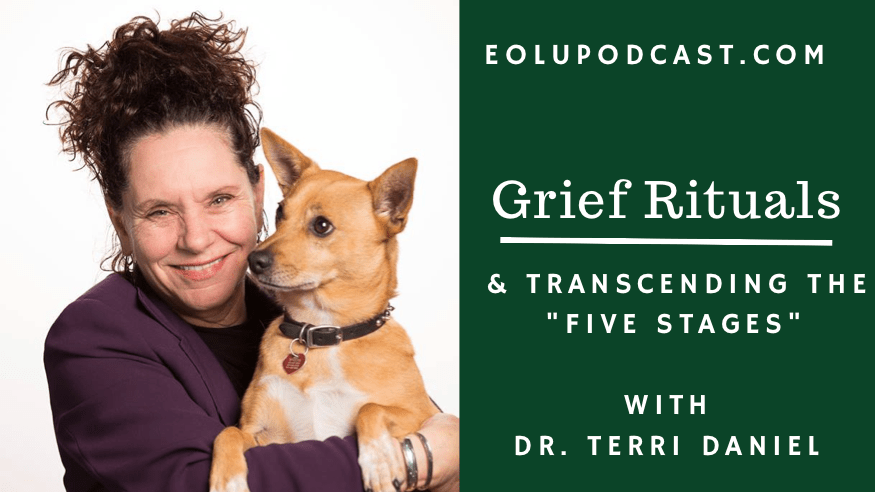
Ep. 399 Grief Rituals and Transcending the “Five Stages” with Dr. Terri Daniel

Learn how rituals can help us with grief and what the Five Stages model gets wrong about grief.

My guest this week is Dr. Terri Daniel, inter-spiritual hospice chaplain, end-of-life educator, and grief counselor. She shares some of the powerful rituals she uses for grief at funerals and workshops and we dive into the Five Stages model and why it continues to be popular in our society. Terri is also the author of four books on death, grief and the afterlife and the founder of The Conference on Death, Grief and Belief, which focuses on how religious beliefs and cultural ideologies influence one’s relationship with death and grief. Learn more at Terri’s websites:

Watch on YouTube

Listen here:

This episode includes:

  • Terri’s journey from caring for her son Danny at the end of his life to the work she is doing now
  • Why she started The Conference on Death, Grief and Belief and how to attend
  • Unique and powerful grief rituals Terri has created for people at the end of their lives and also for funerals and workshops
  • How rituals help us with grief and mourning
  • How the Five Stages model initially became applied to grief
  • What the Five Stages model gets wrong about acceptance
  • How the Five Stages model persists in our society
  • What ChatGPT says about why the Five Stages model is popular
  • Other models for personality and “love languages” that have attained widespread popularity in spite of having no evidence of accuracy (and why this happens)

Links mentioned in this episode:

If you enjoy this content please share it with others and consider leaving a review on iTunes. Thanks again to all supporters on my page at Patreon.com/eolu, especially my latest patron Catherine Paton, and to Anne Jungerman for increasing your pledge, Amrita for buying me a coffee, Suzie Hopkins for your donation on Paypal, and Ray Burleigh for your donation and poem! Your contributions make all the difference.
EOLPodcast

Ep. 398 Spiritual and Emotional Healing of Serious Illness with Lesley Wirth

Learn about the importance of healing the emotions and the soul along with the body during serious illness.

My guest Lesley Wirth is a poet and writer who has a Masters Degree in Spiritual Psychology. She helps women experiencing a “dark night of the soul” by helping them deal with fear and spiritual and emotional pain, including after being diagnosed with serious illness. Lesley is the creator of the programs Poetry for Healing and The Power of Your Intuition. She discusses her work using poetry in workshops and also teaching how to access intuition. Learn more about her work at her website:

www.lesleywirth.com

Watch on YouTube

Listen here:

This episode includes:

  • Lesley’s story of a “dark night of the soul”
  • How a diagnosis of serious illness can lead to an over-focus on the physical aspects of illness while leaving out the emotional and spiritual
  • Why healing requires more than just a physical approach
  • How to deal with fear and anxiety during difficult times
  • Why “positive psychology” may bypass the areas where deep healing is actually needed
  • How poetry can help with healing
  • Why medical providers could benefit from approaching illness as more than just a physical problem

Links mentioned in this episode:

If you enjoy this content please share it with others and consider leaving a review on iTunes. Thanks again to all supporters on my page at Patreon.com/eolu, and to Robin Bissell for your donation on Paypal! Your contributions make all the difference.

EOLPodcast

Ep. 397 Talking About Death with ChatGPT

Learn how the AI language model ChatGPT can be used as a resource for information about death and dying and when caution is required.

My special “guest” this week is ChatGPT an AI language model that can understand and respond to human language. Chat has been trained on a wide range of topics, including end-of-life care, hospice, palliative care, grief and bereavement, and advance care planning, among others. I conducted a written “interview” with Chat to test its knowledge and in this episode I report on my findings. In addition, I’ve compiled all of our correspondence into a book titled Conversations on Death with ChatGPT, which you can access now in ebook format. I hope you enjoy hearing about my adventures with Chat!

Listen here:

This episode includes:

  • What an AI language model consists of and how to interact with it
  • The amazing depth and breadth of content and resources that ChatGPT was able to generate in a matter of seconds
  • What I learned about euphemisms for death from Chat
  • What Chat got wrong about for-profit hospice
  • How Chat needed better information about talking to children about death
  • Chat’s creative ideas for promoting advance care planning in predominantly Black communities
  • Chat’s thoughts about the 5-stages model of grief
  • A haiku Chat wrote about grief
  • How Chat helped me deal with guilt over my father’s suicide death

Links mentioned in this episode:

If you enjoy this content please share it with others and consider leaving a review on iTunes. Thanks again to all supporters on my page at Patreon.com/eolu, especially my newest patrons Susan Mackey and Colleen Bracken, and to Laura Srygley for buying me a coffee and Fabricio Vasconcelos de Lima for donating on Paypal! Your contributions make all the difference.